

You should go to more hackathons
You can’t plan every good thing that happens to you. But you can give it more chances.
Whether you’re a student, have a job, run a startup, or just want to meet people, you should go to more hackathons.
I keep coming back to serendipity. So many good things in my life started with something I couldn’t have planned. A conversation with a stranger. A project I almost didn’t submit. An event I decided to attend.
You can’t predict those moments. But you can put yourself in situations where more of them can happen.
There’s a simulation that made this idea click for me.
Draw a square with a quarter circle inside it. Then start dropping points randomly into the square. Some land inside the curve. Others land outside.
The quarter circle takes up π/4 of the square’s area. So, if you count the points inside the curve, divide by the total number of points, and multiply by four, you get an estimate of π.
π ≈ 4 × points inside the quarter circle / total points
With one point, the estimate is terrible. With a few more, it jumps around. Keep going, and it tends to settle closer to π.
Watch it happen.
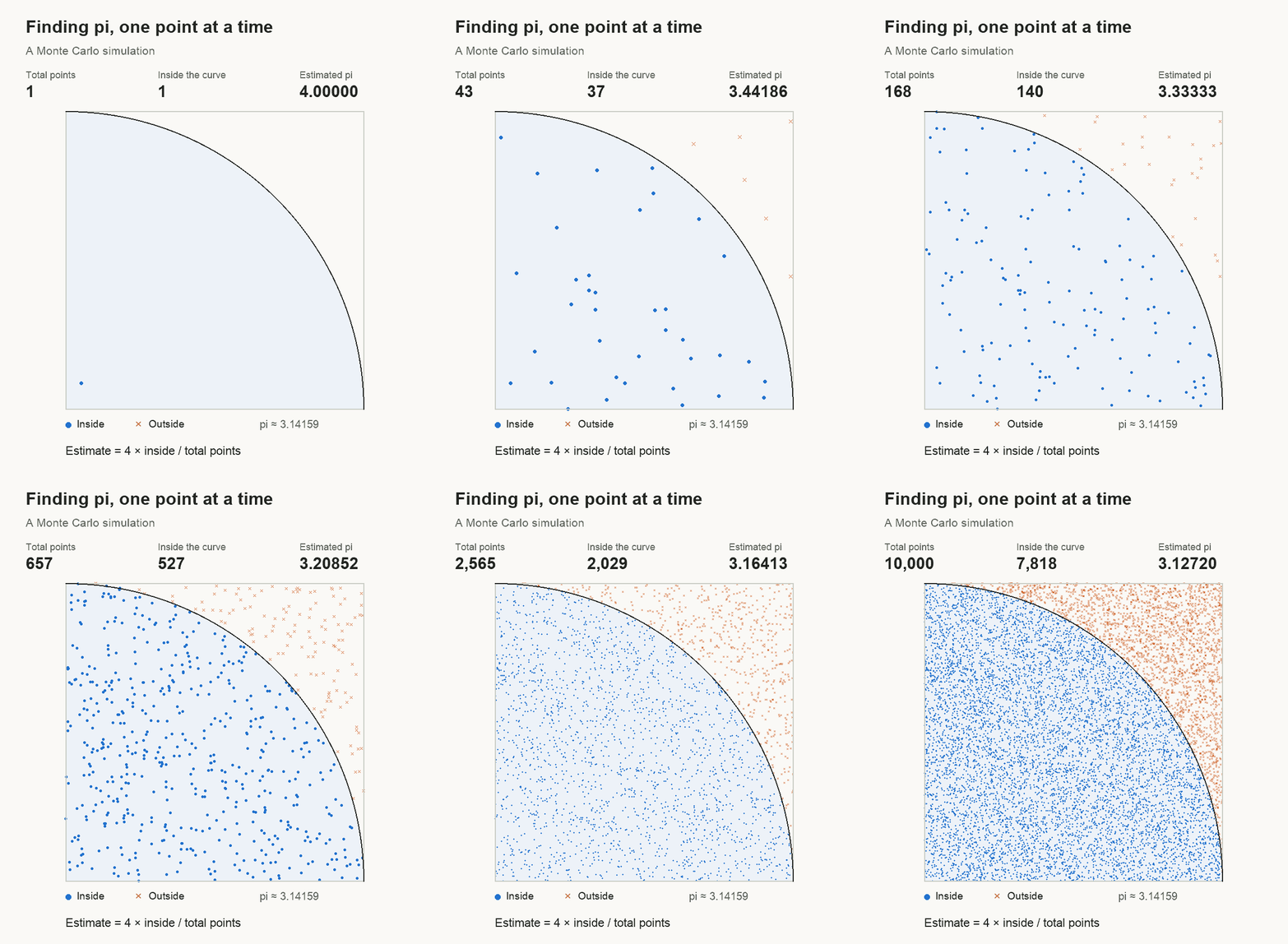
The first time I saw this, I thought it was so cool. Something useful was coming out of a bunch of random attempts.
Of course, the estimate doesn’t improve with every point. Sometimes the next point makes it worse. But with enough points, the result becomes more reliable.
Life doesn’t follow the same equation. Still, I think there’s something useful in that picture. More attempts give good things more chances to happen.
The more people you meet, the more chances you have to meet someone who changes your life. The more apps you build, the more opportunities you have to make something people care about. None of those attempts comes with a guarantee. You make them anyway.
And hackathons are an unusually good place to make a lot of them.

Everyone is building something. Everyone has a reason to be there. You already have something to talk about before you’ve even introduced yourself.
If you don’t know how to start a conversation, look around.
“What are you building?”
That’s enough.
People love talking about something they’re excited about. They also like feeling useful. If you’re stuck on something, ask someone who might know.
“I’m trying to make my app work offline. Have you done that before?”
You have a real problem. They might have an answer. A conversation starts naturally, and you get to learn something.
I also think hackathons should make more room for group conversations.
We all have opinions, especially now. AI is changing how we build software, and everyone is trying different models, workflows, skills, and agent harnesses. I’m curious about what people actually use, what they’ve stopped using, and what they think their jobs will look like in a year.
At Hack the Andes, the best hackathon in Peru, we had a conversation about Grokbot and the role of engineers in a world of personal agents. Founders, mentors, and participants all had different takes. Hearing them talk so openly was one of my favorite parts of the event.
I’d love to see more hackathons make room for that. Give people time to sit together and talk about the things they’re figuring out.

If you’re a founder, you might meet your next engineer there.
Watching someone debug at 3 a.m. with a Red Bull can tell you more than three interviews. You see how they handle frustration, how they work with other people, and what they do when something breaks.
But even a casual conversation can tell you a lot. Ask a participant what they’re building and listen to how they explain it. What got them interested? What have they tried? Why do they care so much about getting this one detail right?
That excitement is worth paying attention to.

If you’re a company, especially one building developer tools, you should be there too.
A lot of the companies that have supported our hackathons have given participants free credits, subscriptions, and merch. Those things help people build. They also give the companies a chance to see what happens when developers actually try their products.
Imagine a hundred people using your tool over 24 hours. You’ll see where they get confused, what they build, and which problems send them straight to your support channel.
If your product is new, be ready for that. Someone should be around to answer questions.
Better yet, be there in person. Sit next to someone while they use your product. Watch where they get stuck. Ask what they expected to happen.
For a developer tools company, that’s a pretty good reason to spend a weekend at a hackathon.
My own history probably explains why I care so much about this.
I entered my first hackathon in 2022. It was an online Xata challenge, and I won $500. I was teaching myself to code, and that win gave me the confidence to keep going.
In 2023, I went to my first hackathon in person. I met people I would eventually work with. Recently, I caught up with a friend who’s in the Founders, Inc. program. We were trying to remember when we’d first met and realized it was at that event.
In 2025, I won Vercel’s global hackathon with three friends. That changed my life. I got job offers from outside Peru and met people I wouldn’t have had access to before.
That same year, I went to Platanus Hack in Chile. To me, it was the best hackathon in the world. It gave me both the inspiration and the standard for organizing AI Hackathon Peru later that year, my first hackathon as an organizer.
Since then, I’ve organized virtual and in person hackathons across cities in Latin America. And I still participate. Recently, I went to one in Amsterdam.
It makes me happy to see more of these spaces growing in Latin America too. I’ve seen what can happen when people get a chance to build together, and I want more people here to experience it.
When I entered that first Xata challenge, I wasn’t planning to organize events across Latin America. I wanted to build something and see if I could finish it.
I couldn’t have planned everything that followed. But I had to enter that first event for any of it to happen.
Maybe I’m biased.
But please. Go to a hackathon.
References:
[1] How to increase your surface area for luck

[2] Hack the Andes’ gallery